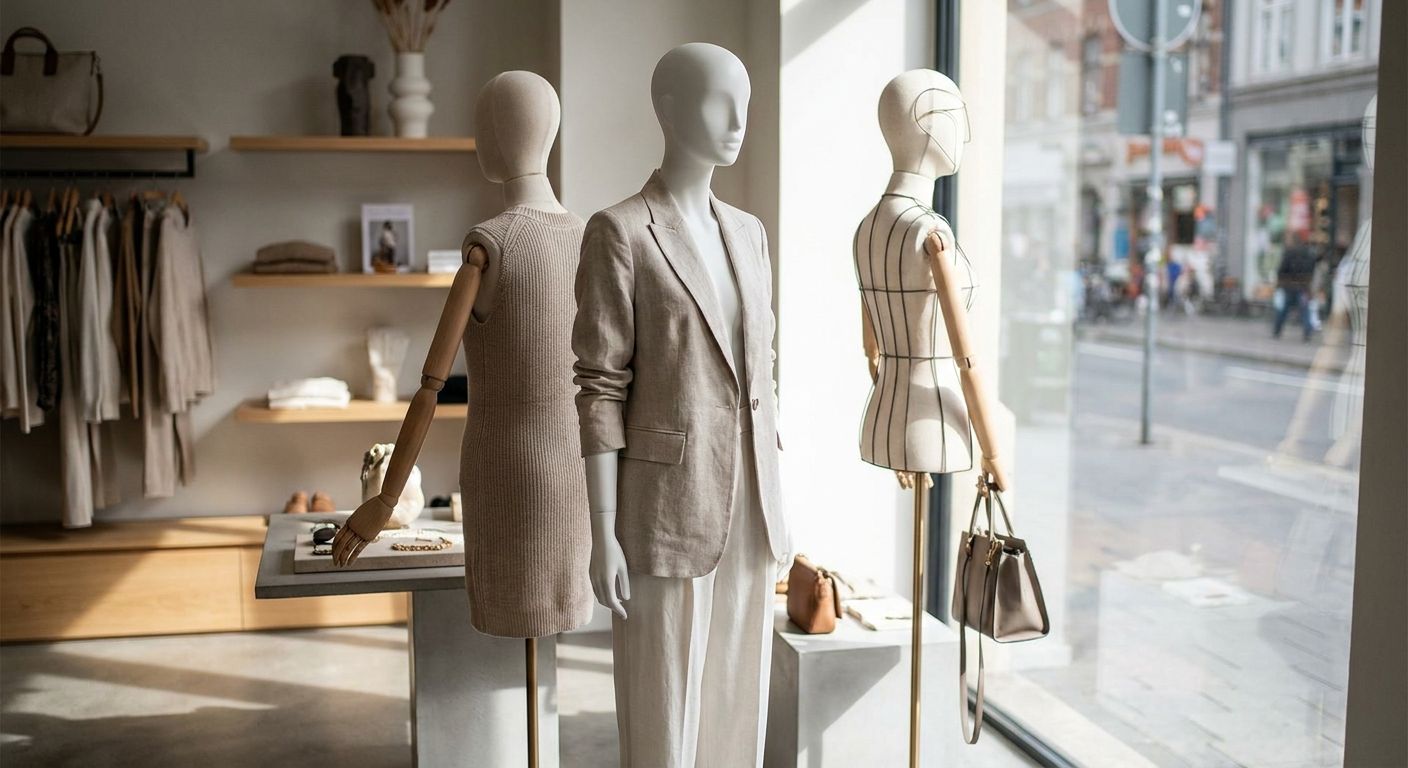
Choosing between a full-body realistic mannequin, a headless form, and an egg-head abstract silhouette shapes how a boutique reads to walk-in traffic before a single price tag gets noticed. This guide ranks the female mannequin types that actually move product on a sales floor in 2026, matched to the display job each one does best.
- Full-body realistic female mannequins win for flagship window displays in 2026 — the face and pose sell the outfit before a customer touches it.
- Headless female mannequins are the fastest to redress and best for high-turnover racks and stockroom-to-floor swaps.
- Egg-head and abstract forms suit minimalist boutique branding but read cold in a warm, mass-market storefront.
- Adjustable-joint mannequins cover the widest range of poses for stores that rotate collections weekly.
- Plus-size female mannequins are still short in supply but build real trust with inclusive-sizing customers.
Why this matters
A boutique's mannequin is doing sales work the staff can't do 24 hours a day — it's the silent pitch in the window and the size reference on the floor. Pick the wrong type and you either burn floor space on a form that can't show full-length garments, or you spend every restock day wrestling a heavy fiberglass torso that was never meant for daily changes.
The Whogohb catalog covers most of these mannequin types, and the type you need depends entirely on where the display sits — window, rack, counter, or fitting room — not on which one looks most premium in a photo. Before ordering, it's worth checking a mannequin cost guide for Nigeria to budget for the type that actually fits your floor plan.
Best overall for boutique displays: full-body realistic female mannequins. Best for fast outfit changes: headless female mannequins. Best for minimalist branding: egg-head abstract mannequins. Best for stores with weekly collection rotations: adjustable-joint mannequins.
What makes the best female mannequin for boutique displays
- Build material — fiberglass holds up better than plastic under daily handling and Nigerian heat and humidity.
- Head and face styling — realistic, egg-head, or headless changes how approachable the display feels to walk-in customers.
- Pose and adjustability — fixed pose versus pivoting joints determines how many looks one mannequin can carry.
- Size accuracy — a mannequin built to the wrong frame misrepresents how a garment actually drapes.
- Base stability — a wobbly stand near a busy aisle is a liability, not a display asset.
- Ease of dressing — removable limbs and headless designs cut redress time on high-turnover racks.
Female mannequin types at a glance
| Mannequin type | Best for | Standout feature | Key limitation |
|---|---|---|---|
| Full-body realistic | Window displays | Lifelike face and pose | Heavy, slow to redress |
| Headless | Fast outfit changes | Quick redress, no face upkeep | Weaker window presence |
| Egg-head / abstract | Minimalist branding | Never looks dated | Reads cold in warm store settings |
| Adjustable-joint | Weekly collection rotation | Multiple poses on one form | Joints loosen with heavy handling |
| Half-body / dress form | Tailoring counters | Minimal floor footprint | Can't show full-length garments |
| Plus-size | Inclusive-sizing boutiques | Represents real customer body range | Fewer suppliers stock the range |
1. Full-body realistic female mannequin: best for boutique window displays
This is the form with a sculpted face, styled pose, and proportions built to a standard female frame — the one doing the actual street-facing selling. It's the type most boutiques picture when they think "mannequin," and for a flagship window it earns that spot.
Full-body realistic mannequin pros:
- Draws attention from street traffic before anyone enters the store
- Shows garment drape close to how it sits on a real customer
- Works with wigs, accessories, and full styling for a complete look
Full-body realistic mannequin cons:
- Heavier fiberglass build makes it slower to move and redress
- Needs more storage room when swapping seasonal outfits
- A dated facial style can make the whole window feel stale
Best for: flagship windows and single-outfit hero displays. Verdict: Buy for any boutique with street-facing window space.
2. Headless female mannequin: best for fast outfit changes
A torso-and-limbs form without a head, built to put every bit of attention on the clothing rather than a face. It's the workhorse type on busy sales floors that restock daily.
Headless mannequin pros:
- Fastest type to redress during restocks
- No facial style to go out of fashion
- Blends into almost any store theme without clashing
Headless mannequin cons:
- Less impact for window or street-facing displays
- Hats, scarves, and eyewear have nothing to sit on
Best for: high-turnover racks and interior floor displays. Verdict: Buy for boutiques changing outfits multiple times a week.
3. Egg-head / abstract female mannequin: best for minimalist boutique branding
A smooth, featureless head on a simplified silhouette — common in contemporary retail concepts that want the display to feel curated rather than lifelike.
Egg-head mannequin pros:
- Never looks facially dated, unlike realistic sculpts
- Fits monochrome or high-fashion store concepts cleanly
- Generally lighter to handle than a detailed realistic bust
Egg-head mannequin cons:
- Reads cold in a warm, mass-market boutique setting
- Doesn't work for hat, eyewear, or accessory-forward displays
- Less relatable for customers who want to picture themselves in the outfit
Best for: boutiques already running a minimalist visual identity. Verdict: Hold — only pick this type if the brand identity calls for it.
4. Adjustable-joint female mannequin: best for multi-collection boutiques
Built with pivoting joints at the shoulders, hips, and sometimes knees, this type lets one mannequin carry several poses and fit a wider range of garment cuts over time.
Adjustable-joint mannequin pros:
- One form covers multiple display needs across seasons
- Useful for stores rotating collections weekly
- Shows movement well for activewear, dresses, and layered looks
Adjustable-joint mannequin cons:
- Moving joints can loosen under heavy daily handling
- Takes more setup time than a fixed-pose form
Best for: boutiques that change their entire display concept often. Verdict: Buy for stores with frequent visual merchandising changes.
5. Half-body / dress form female mannequin: best for tailoring counters
A torso-only stand with no legs or arms, used at alteration counters and in boutiques with tight floor space where a full form doesn't fit.
Half-body dress form pros:
- Minimal floor footprint compared to any full-body type
- Ideal for pinning, fitting, and alteration work
- Lower cost of acquisition relative to full-body forms
Half-body dress form cons:
- Can't show full-length garments like dresses or trousers convincingly
- Almost no value as a window display piece
Best for: tailoring-focused boutiques and small counter spaces. Verdict: Buy for fitting work; Skip for full-outfit window displays.
6. Plus-size female mannequin: best for inclusive-sizing boutiques
Built to larger body proportions than the standard size 6-8 frame, this type lets shoppers see a garment on a body closer to their own rather than only on the industry-standard silhouette.
Plus-size mannequin pros:
- Builds trust with plus-size customers immediately
- Differentiates a boutique in a market still short on inclusive-size retail props
- Works in both window and floor settings
Plus-size mannequin cons:
- Fewer suppliers stock this size range consistently
- Fitted accessories often need separate sourcing to match proportions
Best for: boutiques where plus-size stock is a real part of the customer base. Verdict: Buy if inclusive sizing is part of the range; Skip if the store carries only standard sizing.
Match your display to the right mannequin
Browse the female mannequin range and pick the type that fits your floor plan.
How we ranked these
Each type is ranked against the six criteria above — build material, head styling, pose flexibility, size accuracy, base stability, and dressing speed — then matched to one boutique use case where it clearly outperforms the rest. No two types share a "best for" slot, because a window display and a stockroom rack are not solving the same problem in 2026.
Which female mannequin should you choose?
For most boutiques opening or refreshing a display in 2026, the full-body realistic female mannequin is the default pick for the window and the headless female mannequin is the default pick for the floor. Stores that rotate collections weekly should add an adjustable-joint form to that pair. Tailoring counters need a half-body dress form regardless of what sits in the window. If plus-size stock is part of the range, a plus-size mannequin belongs in the mix from day one, not as an afterthought.
FAQ
What's the best female mannequin for boutique window displays?
A full-body realistic female mannequin is the best choice for boutique window displays in 2026 because the sculpted face and pose sell the outfit to street traffic before anyone enters the store.
Is a headless mannequin better than a full-body mannequin?
A headless mannequin is better for fast, frequent outfit changes on interior racks, while a full-body mannequin performs better for window displays that need a complete, lifelike look.
What size are standard female mannequins built to?
Most standard female mannequins are built to a size 6-8 frame at roughly 172 cm (5'8") tall, which is the reference size manufacturers use across the industry.
Are egg-head mannequins good for a boutique?
Egg-head mannequins work well for boutiques with a minimalist visual identity, but they read cold in a warm, mass-market store setting and aren't suited to hat or accessory displays.
Do adjustable mannequins wear out faster?
Adjustable-joint mannequins have moving parts that can loosen with heavy daily handling, so they need more careful setup than a fixed-pose form, though they cover more display poses over time.
What mannequin should a small boutique with limited floor space use?
A half-body dress form is the best fit for small floor space since it takes up minimal room and works well at tailoring or alteration counters, though it can't show full-length garments.
Are plus-size mannequins widely available?
Plus-size female mannequins are less common than standard size 6-8 forms because fewer suppliers stock that range consistently, so sourcing usually takes more lead time.
How many mannequin types does a boutique actually need?
Most boutiques run at least two types in 2026 — a full-body realistic mannequin for the window and a headless mannequin for interior racks — with a half-body dress form added if tailoring is offered.
One last thing
The mannequin that gets skipped most often in boutique planning is the half-body dress form — store owners buy full-body forms for everything, then end up storing them unused at the counter where a dress form would have done the fitting job in a fraction of the space. Match the form to the job first, then worry about styling it.