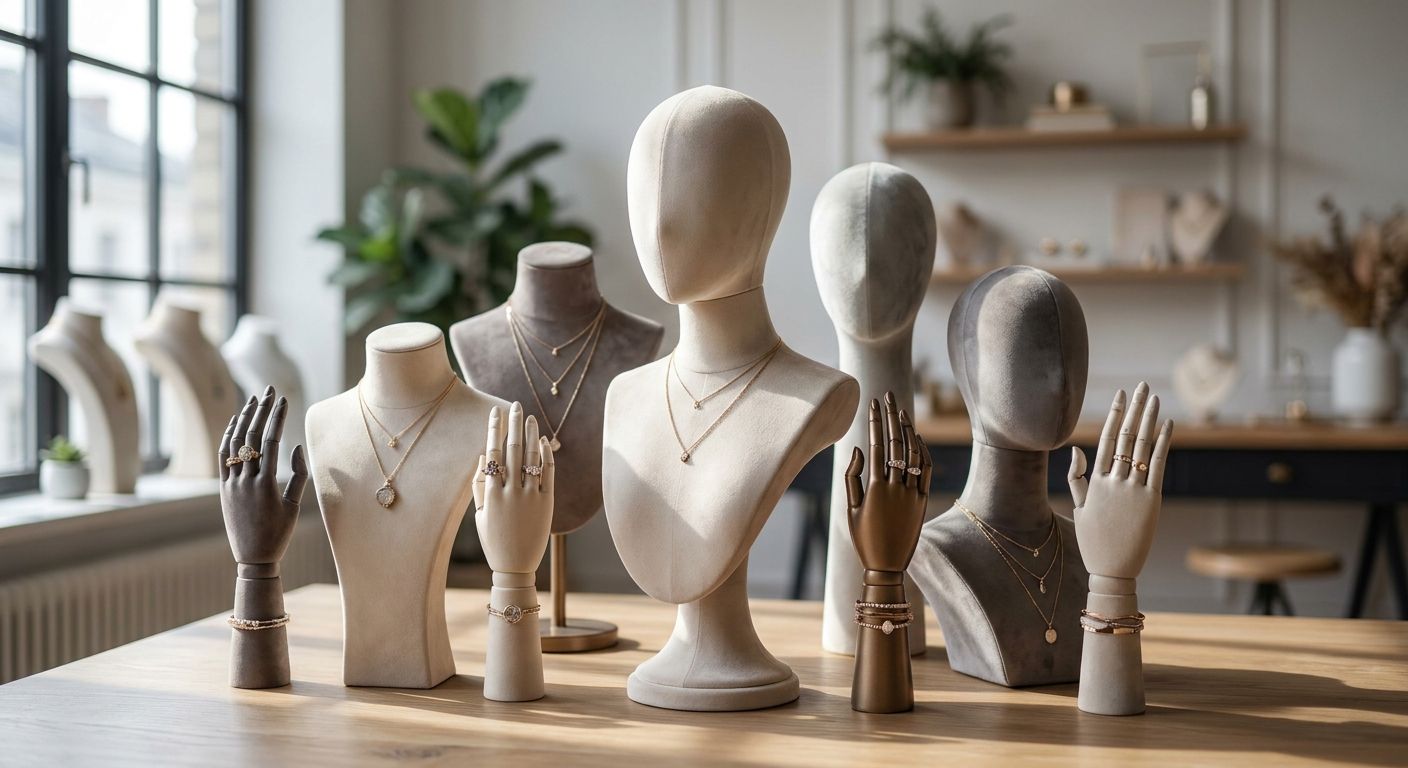
The best jewelry display mannequin in 2026 for most Nigerian boutiques is a velvet-covered neck bust for pendants and chokers, backed by a linen torso form for layered necklace sets and a hand-and-wrist form for bracelets and rings. Full-body mannequins earn their place only in stores that pair jewelry with clothing, and a rotating tabletop stand wins wherever counter space is tight.
- A velvet neck bust is the best jewelry display mannequin for pendants, chokers and layered necklaces in 2026.
- Hand-and-wrist forms show how bracelets and rings sit on skin, unlike flat velvet trays.
- Full-body mannequins fit combined fashion-and-jewelry displays; skip them for counter-only jewelry stores.
- Linen and velvet finishes photograph better than bare plastic forms for e-commerce jewelry listings.
- Sourcing jewelry display mannequins locally in Nigeria in 2026 cuts import wait times and duty costs.
Why this matters
Jewelry sells on how it sits on a body, not how it lies flat in a drawer. A ring on a hand form looks different from the same ring on a glass shelf, and a pendant on a neck bust shows drop length and chain weight that a flat tray hides completely.
Retailers who move from trays to proper jewelry display mannequins tend to see shoppers handle fewer pieces before deciding, because the mannequin already answered the fit question. Whogohb stocks the jewelry display mannequin range — busts, hand forms, and full-body pieces — that fashion houses and jewelry counters across Nigeria use to fill that exact gap, alongside the hangers and racks that sit around them.
The right mannequin changes with the jewelry category on sale, not with store size. That's why this guide ranks by use case in 2026 instead of by brand.
What makes the best jewelry display mannequin
Six things separate a display piece that sells jewelry from one that just holds it:
- Finish and material — velvet and linen absorb light and read as premium; bare plastic and shiny resin throw glare that photographs badly.
- Base stability — a weighted or wide base stops a fully-loaded necklace bust from tipping when a customer leans in.
- Skin-tone realism on hand and wrist forms — a bracelet or ring reads wrong on a stark white form; neutral tan or beige tones sell better.
- Adjustability — rotating necks, positionable fingers, and interchangeable stands let one piece serve several jewelry categories.
- Cleaning and handling — fabric covers need to survive daily handling and dusting without pilling or discoloring.
- Fit for counter or floor — a tabletop stand needs a different footprint than a full-body form; size the mannequin to the space, not the other way around.
Jewelry display mannequins at a glance
Here's how the six types stack up side by side before the full breakdown below.
| Mannequin type | Best for | Standout feature | Key limitation |
|---|---|---|---|
| Velvet neck bust | Pendants, chokers, layered necklaces | Curved neckline shows chain drop and layering | Can't display bracelets or rings |
| Linen torso/bust form | Multi-strand necklace sets, statement collars | Wider chest area fits bold collar pieces | Bulkier footprint than a neck bust |
| Hand-and-wrist form | Bracelets, bangles, rings | Realistic finger and wrist curvature | Limited to hand-worn jewelry only |
| Full-body mannequin | Combined fashion-and-jewelry lookbooks | Shows jewelry styled with an outfit | Needs floor space a counter store may not have |
| Rotating tabletop stand | Small counters, tight retail floors | 360-degree rotation without moving the piece | Holds fewer items than a full bust |
| Earring display block | Stud and drop earring counters | Slotted rows keep pairs matched | Single-purpose, no other jewelry category |
1. Velvet neck bust: best jewelry display mannequin for pendants and chokers
A velvet-covered neck-and-shoulder form angled to show how a pendant or choker drops and rests against a collarbone line. Most versions rotate or tilt slightly, so the same piece reads from more than one angle without a customer touching it.
Velvet neck bust pros:
- Shows chain length and drop weight accurately
- Fabric finish photographs well under counter lighting
- Small footprint fits most glass display cases
- Works for single pendants and multi-layer stacks alike
Velvet neck bust cons:
- Cannot show bracelets, rings, or earrings
- Fabric covers need periodic replacement once handling wears the nap
Best for: pendant, choker, and layered-necklace counters. Verdict: Buy.
2. Linen torso form: best for multi-strand and statement collar pieces
A wider bust form, usually linen or cotton-covered, built for bold collar necklaces and multi-strand sets that need more chest width than a neck bust offers.
Linen torso form pros:
- Handles heavier, wider necklace styles without crowding
- Neutral linen tone doesn't compete with gemstone color
- Doubles as a display for scarves or light layering pieces
Linen torso form cons:
- Bulkier than a neck bust, so it eats more counter or shelf space
- Overkill for single thin-chain pendants
Best for: statement collars and multi-strand sets. Verdict: Buy.
3. Hand-and-wrist form: best for bracelets, bangles, and rings
A resin or fabric-wrapped hand form, mounted at a natural wrist angle, made to hold bracelets, bangles, and rings the way they sit on skin.
Hand-and-wrist form pros:
- Realistic finger spacing shows ring sizing and stacking
- Neutral tan or beige finishes work across most jewelry tones
- Compact enough for multiple units along one counter
Hand-and-wrist form cons:
- Only serves hand-worn categories, so it can't replace a neck bust
- Cheaper resin versions crack at the wrist joint under repeated handling
Best for: bracelet, bangle, and ring counters. Verdict: Buy.
4. Full-body mannequin: best for combined fashion-and-jewelry lookbooks
A complete standing mannequin dressed in an outfit and styled with jewelry pieces layered on top, used mostly where clothing and jewelry sell from the same floor or storefront photo.
Full-body mannequin pros:
- Shows jewelry in a real styled context, not isolated
- Doubles as clothing display when jewelry isn't the focus that week
- Strongest option for storefront window displays
Full-body mannequin cons:
- Needs floor space most jewelry-only counters don't have
- Jewelry gets visually competed with by the outfit itself
- Slower to restyle than swapping a piece on a bust
Best for: fashion houses selling jewelry alongside clothing. Verdict: Hold for jewelry-only counters, Buy for combined fashion floors.
5. Rotating tabletop stand: best for tight counter space
A small, weighted rotating stand — sometimes bare, sometimes fitted with a mini bust or hand form on top — built for counters where floor-standing mannequins won't fit.
Rotating tabletop stand pros:
- Smallest footprint on this list
- Rotation lets one piece face multiple angles without staff resetting it
- An easy upgrade from flat trays without committing to a full bust
Rotating tabletop stand cons:
- Holds fewer pieces at once than a full bust or torso form
- Motorized versions need power access near the counter
Best for: small stores and tight retail counters. Verdict: Buy.
6. Earring display block: best for stud and drop earring counters
A slotted foam, wood, or acrylic block that holds earring pairs upright in matched rows, keeping studs and drops sorted and visible without tangling.
Earring display block pros:
- Keeps pairs matched, which cuts staff time hunting for a missing stud
- Cheapest single-purpose fixture on this list to maintain
- Stacks or tiers easily for a full earring counter
Earring display block cons:
- Single-purpose — does nothing for necklaces, bracelets, or rings
- Slotted foam versions wear out faster than wood or acrylic
Best for: earring-only counters and display cases. Verdict: Buy as a companion piece, not a standalone jewelry display mannequin.
Shop jewelry display mannequins
Browse jewelry display mannequin fixtures from Whogohb for jewelry counters.
Common mistakes that hurt jewelry display
A few missteps show up again and again in jewelry counters and small fashion houses:
- Using clothing mannequins for jewelry. A dress form's proportions distort how a necklace or bracelet actually sits; dedicated hand-and-wrist forms and neck busts read closer to true size.
- Skipping the base weight. A light bust tips when a customer leans in to inspect a heavier piece, and a fallen mannequin damages the jewelry on it.
- Ignoring lighting and fabric color together. Velvet in the wrong shade absorbs too much light under counter spotlights, dulling gemstone sparkle instead of framing it.
- Buying one mannequin type for every jewelry category. A single neck bust can't also show how a ring sits; mixing hand forms, neck busts, and earring blocks covers more of the counter's actual inventory.
- Treating the mannequin as permanent. Fabric covers wear out with daily handling — plan to replace or re-cover them rather than running a faded bust for years.
How this ranking works
Every mannequin type above is scored against the six criteria higher up this page: finish, base stability, skin-tone realism, adjustability, cleaning demands, and counter-versus-floor fit. A velvet neck bust and a hand-and-wrist form top the list because they solve the two jewelry categories — necklaces and hand-worn pieces — that carry the most foot-traffic decisions at a typical Nigerian jewelry counter in 2026.
Full-body mannequins rank lower for jewelry-only stores not because they're worse-made, but because they solve a different problem: styling a look, not close-up jewelry inspection.
Which jewelry display mannequin should you choose?
If you sell mostly necklaces and pendants, the velvet neck bust is the safest default purchase for 2026 — it fits nearly every counter and photographs well for online listings. Add a hand-and-wrist form the moment bracelets or rings enter your case, since a flat tray under-sells both.
Full-body mannequins only make sense once jewelry sits inside a broader fashion display, and a rotating tabletop stand solves the space problem better than shrinking a full bust. Whichever jewelry display mannequin fits your counter, match the finish and base weight to how customers actually handle the pieces, not just how the fixture looks empty on a shelf.
FAQ
What's the best jewelry display mannequin for a small counter?
A rotating tabletop stand is the best jewelry display mannequin for small counters in 2026 because it holds one or two pieces in a footprint smaller than a neck bust. Pair it with an earring block if the same counter also sells studs.
Is a hand form better than a flat velvet tray for bracelets?
Yes, a hand-and-wrist form shows how a bracelet or bangle actually sits on skin, while a flat tray only shows the piece lying open. Shoppers judge fit faster on a hand form, which shortens the decision time at the counter.
How much does a jewelry display mannequin cost in Nigeria in 2026?
Cost depends on material, size, and finish, and varies by supplier through 2026. Check current pricing directly with a Nigerian fixture supplier before ordering, since import and local-stock pricing can differ.
What material lasts longest for daily handling?
Linen and velvet-covered forms with a solid resin or wood core outlast bare plastic under daily handling, because the fabric hides scuffs that show on shiny plastic. Cheaper foam-core versions wear out fastest at pressure points like wrists and necklines.
Can one mannequin display more than one jewelry category?
A full-body mannequin can carry necklaces, earrings, and bracelets at once because it's styled as a full look, but a neck bust or hand form is built for one category only. Counters selling several jewelry types usually run more than one mannequin type side by side.
Do full-body mannequins work for jewelry-only stores?
Full-body mannequins work best when jewelry sells alongside clothing, not in a jewelry-only counter or case. A jewelry-only store gets more display value per square foot from a neck bust or hand form.
What color hand-and-wrist form should I buy?
A neutral tan or beige hand-and-wrist form works across the widest range of jewelry tones in a retail setting. Stark white forms tend to throw glare under counter lighting and can make gemstone color read incorrectly.
How many neck busts does a small jewelry counter need?
Most small jewelry counters run more than one neck bust so staff can restyle one while others stay on display. The right count depends on how often you rotate necklace styles, not on store size alone.
One last thing
Before you order, run the numbers on landed cost, not just a supplier's sticker price — freight, packaging, and import duty on fixtures shift through the year. The mannequin cost guide for Nigeria in 2026 breaks down what actually drives that number by material and size, which matters more for a jewelry display mannequin than the base type you pick from this list.