Menswear stores in Nigeria buying mannequins in 2026 need to match the mannequin to the display job, not the other way round. Best overall for a flagship menswear floor: full-body realistic male mannequins. Best for high-turnover retail: headless male mannequins. Best budget-of-space pick for tailors and small shops: the male torso or half-body form.
- Full-body realistic male mannequins win for flagship menswear displays that need to sell a full look, head to shoe.
- Headless male mannequins cut restocking time on busy retail floors where outfits change daily.
- Abstract egghead forms suit minimalist, high-fashion menswear boutiques that don't want a face competing with the clothes.
- Torso and half-body forms fit tailors and small counters where floor space is the real constraint.
- Adjustable dress forms are the only option built for fitting and alteration work, not display.
Why this matters
A mannequin is the silent salesperson on your shop floor, and the wrong one either buries your stock or drives customers past it. Menswear specifically punishes a bad choice: suits, blazers, and structured outerwear need shoulders, chest, and drape shown accurately, which a cheap or mis-sized form won't do. Whogohb supplies mannequins and shop fixtures across Nigeria, and the recurring mistake among menswear retailers in 2026 is buying one generic mannequin type for a store that actually needs two or three, one for the window, one for the counter, one for the fitting room.
What makes the best male mannequin for a menswear store
- Sizing that matches your stock. Most menswear mannequins are built to a size 40 chest, the most common off-the-rack suit size, so garments hang the way they will on a real customer.
- Correct standing height. Standard male display forms run close to 6 feet (183 cm), which keeps trouser breaks and sleeve lengths honest.
- Finish that suits the category. Matte skin tones and fabric-wrapped finishes photograph better for suiting; glossy finishes work fine for streetwear and denim.
- Pose flexibility for the display type. Fixed-pose forms are cheaper and faster to dress; articulated forms cost more effort but earn their keep in window storytelling.
- Floor footprint versus stock volume. A store with limited counter space gains more from torso forms than from full-body pieces that eat square footage.
- Durability under repeated dressing. Menswear staff redress mannequins constantly during sales cycles; joints and stands need to survive that without cracking.
At a glance: male mannequin types for menswear stores in 2026
| Mannequin type | Best for | Standout feature | Key limitation |
|---|---|---|---|
| Full-body realistic | Flagship menswear displays | Shows a complete outfit head to shoe | Needs the most floor space |
| Headless | High-turnover retail floors | Fast to dress and undress | Loses the face-forward impact of window shots |
| Abstract / egghead | Minimalist, high-fashion boutiques | Draws the eye to the clothing, not the face | Less relatable for casual shoppers |
| Articulated / posable | Window displays and editorial styling | Movable joints allow dynamic poses | More expensive and slower to dress |
| Torso / half-body | Small counters and tight floor plans | Tiny footprint, easy to store | Can't show trousers, shoes, or full drape |
| Adjustable dress form | Tailoring and alteration shops | Built for fitting work, not display | Not meant to be shopper-facing |
1. Full-body realistic male mannequin: best for flagship menswear displays
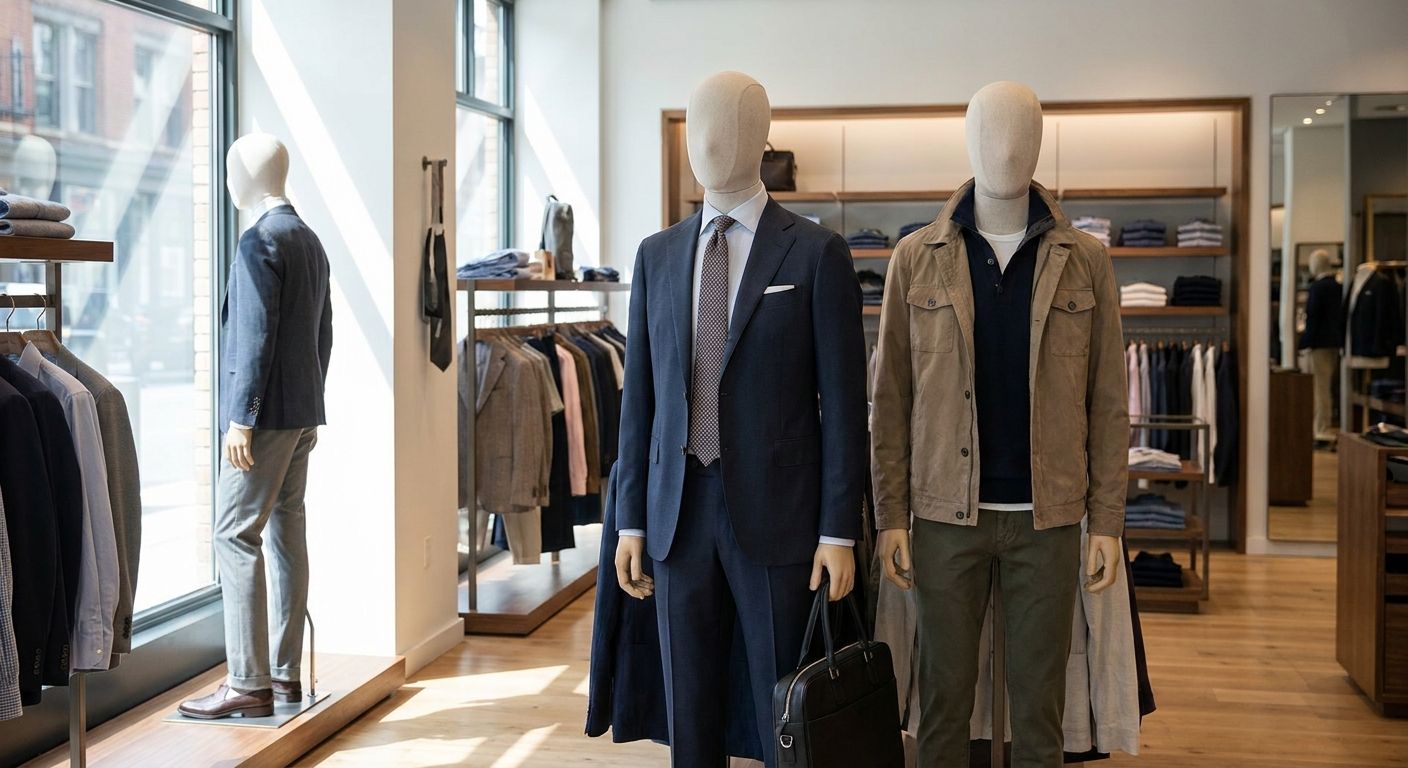
A full-body realistic mannequin shows an entire outfit the way a customer will actually wear it, shoulders to shoe. It's the only type that lets a menswear store sell a complete look, suit plus shirt plus tie plus shoes, in one glance from the street.
Full-body realistic mannequin pros:
- Sells the full outfit, not just the top half
- Realistic proportions match how suits and outerwear are cut
- Strongest option for window displays that need to stop foot traffic
Full-body realistic mannequin cons:
- Needs the most floor and storage space of any type on this list
- Slower to dress and redress than headless or torso options
Best for: flagship stores and street-facing windows where the mannequin is the first thing a passerby sees. Verdict: Buy if your window is your main acquisition channel.
2. Headless male mannequin: best for high-turnover retail floors
A headless form strips away the face so staff can dress and undress it in seconds, which matters in stores that rotate stock weekly or run frequent promotions. It keeps the customer's attention on the garment rather than a fixed expression.
Headless mannequin pros:
- Fastest to dress and redress of the full-body options
- Cheaper to replace or repair since there's no facial detail to match
- Works across menswear categories, from casualwear to formal
Headless mannequin cons:
- Loses the visual pull of a face-forward window display
- Feels impersonal in a boutique setting built around a curated, styled feel
Best for: busy retail floors with fast stock cycles and staff turnover. Verdict: Buy for high-volume stores; Skip if your brand leans on a styled, editorial storefront.
3. Abstract egghead male mannequin: best for minimalist high-fashion boutiques
The egghead form has a smooth, featureless head and a stylized body, built for stores where the clothing itself is the entire message. It's common in higher-end menswear because it avoids competing with the garment's silhouette.
Egghead mannequin pros:
- Keeps shopper focus entirely on the clothing
- Ages well visually since there's no facial detail to look dated
- Fits a minimalist, gallery-style store layout
Egghead mannequin cons:
- Feels cold or unrelatable in stores selling casual or streetwear
- Doesn't work as well for family-facing or mid-market menswear shops
Best for: designer or high-fashion menswear boutiques with a curated, minimal aesthetic. Verdict: Buy for premium positioning; Wait if your customer base skews casual and value-driven.
4. Articulated posable male mannequin: best for window displays and editorial styling
Articulated forms have movable joints at the shoulders, elbows, hips, or knees, letting staff create dynamic poses instead of the standard stiff stance. This is the type that turns a window into a scene rather than a rack.
Articulated mannequin pros:
- Creates poses that mimic real movement, useful for lifestyle-style displays
- Differentiates a window from every static mannequin on the same street
- Works well for seasonal campaigns and editorial-style merchandising
Articulated mannequin cons:
- Takes longer to pose and dress correctly than a fixed-stance form
- Joints see more wear with frequent repositioning, so build quality matters more here than anywhere else on this list
Best for: stores running seasonal windows or editorial-style campaigns. Verdict: Buy if display changes are a marketing tool for you, not just housekeeping.
5. Male torso half-body mannequin: best for small counters and tight floor plans
A torso or half-body form cuts off below the hip or waist, which shrinks the footprint dramatically compared to a full-body piece. It's built for counters, shelves, and any space where floor real estate is the binding constraint.
Torso mannequin pros:
- Smallest footprint of any option on this list
- Easy to store, move, and swap between displays
- Works well for shirts, jackets, and layered tops without needing trouser or shoe styling
Torso mannequin cons:
- Can't display trousers, shoes, or full silhouette drape
- Not suited to showing a complete head-to-toe outfit
Best for: small shops, kiosks, and tailors with limited counter or shelf space. Verdict: Buy for space-constrained stores; Skip if your main product is suiting that needs full-length display.
6. Adjustable male dress form: best for tailoring and alteration shops
An adjustable dress form is built for fitting work, not display, letting a tailor pin, drape, or check a garment's fit across a range of body sizes on one form. It's the odd one out on this list because it's a working tool rather than a shopper-facing fixture.
Adjustable dress form pros:
- Lets one form stand in for multiple client sizes
- Speeds up alteration and made-to-measure work
- Pays for itself in tailoring shops that fit garments daily
Adjustable dress form cons:
- Not designed to be attractive or shopper-facing
- Adds no value to a store that only sells off-the-rack stock
Best for: tailors, alteration counters, and made-to-measure menswear services. Verdict: Buy if fitting is part of your service; Skip entirely for pure retail.
How this ranking was built
Each type was scored against the six criteria above: sizing accuracy, standing height, finish quality, pose flexibility, floor footprint, and durability under repeated dressing. No two types share a "best for" slot, because a menswear store rarely needs just one mannequin type across its window, counter, and fitting room.
Talk to Whogohb about your floor plan
Get guidance on which mannequin type fits your store layout and stock.
Which male mannequin should you choose?
For most menswear stores opening or refreshing a floor in 2026, the full-body realistic mannequin is the default choice for the window, and a headless form is the workhorse for everything else on the floor. Add a torso form if counter space is tight, and only add an adjustable dress form if fitting or alterations are part of the business. Budget is the other real variable here: costs shift with size, material, and finish, and the mannequin cost guide for Nigeria walks through what drives that pricing before you order.
FAQ
What's the best male mannequin for a small menswear boutique?
A torso or half-body form is the best fit for small boutiques because it takes up the least floor space while still showing shirts, jackets, and layered tops. Add one full-body form near the entrance if window impact matters more than floor space.
Is a headless mannequin better than a full-body one for menswear?
Neither is universally better; headless mannequins win on speed for high-turnover stores, while full-body mannequins win for window displays that need to sell a complete look. Most menswear stores in 2026 use both, split between window and floor.
How much do mannequins cost in Nigeria in 2026?
Cost depends heavily on size, material, finish, and whether the mannequin is fixed-pose or articulated. Pricing varies enough between suppliers that it's worth checking current options before budgeting a full-floor refresh.
What size mannequin should a menswear store buy?
Most menswear mannequins are built to a size 40 chest and roughly 6 feet (183 cm) in height, matching the most common off-the-rack suit size. Stores selling slimmer or larger cuts should ask suppliers about matching sizing before ordering.
Are articulated mannequins worth it for window displays?
Yes, if the window is used for seasonal or editorial-style campaigns where a dynamic pose adds visual interest. They're not worth the extra dressing time for stores that keep the same static setup for months.
Can one mannequin type work for both suits and casualwear?
A full-body realistic mannequin can carry both categories since it shows the complete outfit, but the finish and pose should match the category, formal poses for suiting, relaxed poses for casualwear.
What's the difference between an egghead mannequin and a realistic one?
An egghead mannequin has a smooth, featureless head built to keep attention on the clothing, while a realistic mannequin has detailed facial features meant to feel relatable to shoppers. Egghead forms suit minimalist, high-fashion stores; realistic forms suit mainstream retail.
Do tailors need a different mannequin than a retail store?
Yes. Tailors need an adjustable dress form built for fitting and alteration work, while retail stores need display-focused forms like full-body, headless, or torso mannequins meant to be shopper-facing.
One last thing
The mistake that costs menswear stores the most in 2026 isn't picking the wrong mannequin type, it's buying one type for the entire store. A flagship window, a busy sales floor, and a fitting counter each pull toward a different form on this list, and stores that mix types get more mileage out of every square foot than stores that standardize on one.