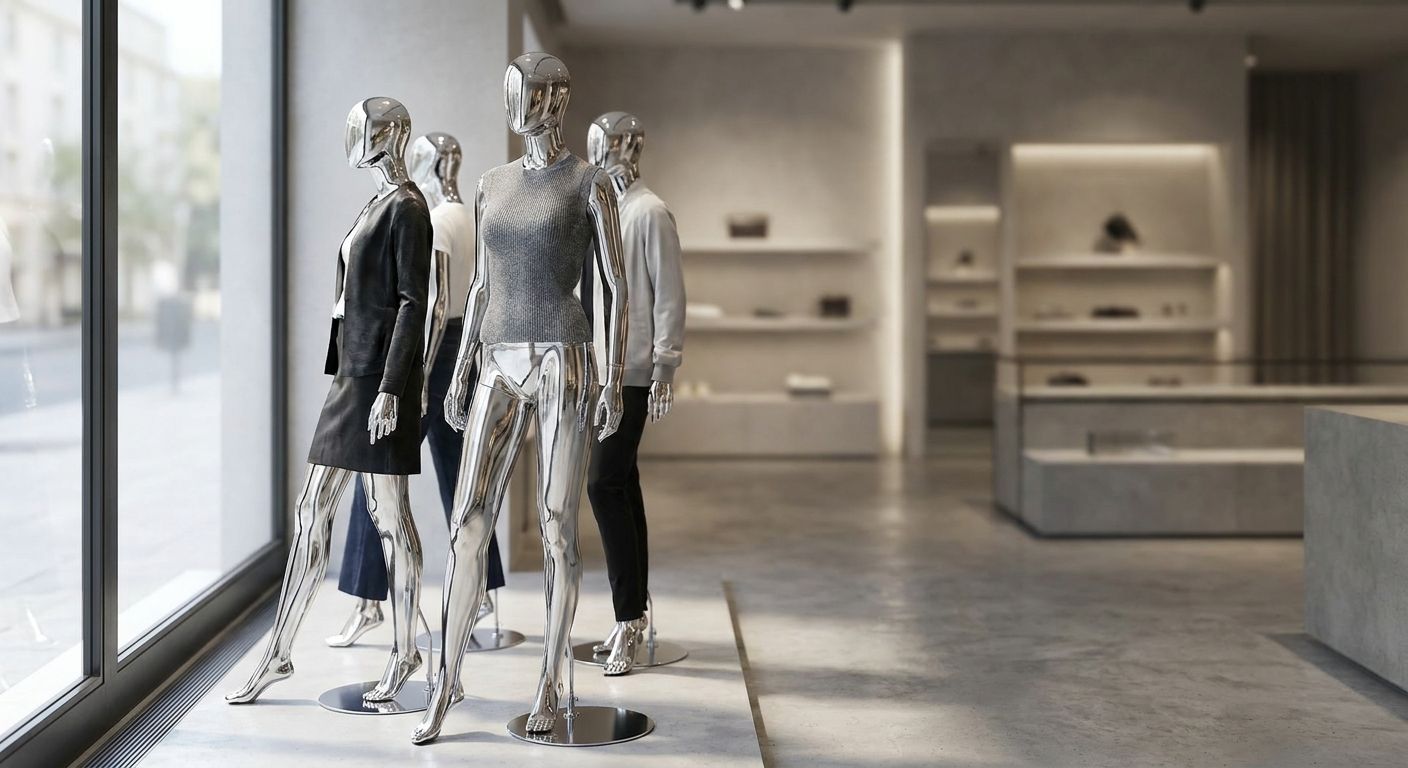
Chrome mannequins are having a real moment in Nigerian retail in 2026, and picking the wrong type wastes floor space you don't have. Chrome full-body mannequins win overall for boutique window displays, chrome headless mannequins win for stores that rotate outfits weekly, and chrome jewelry mannequins win for accessory counters — the type you need depends entirely on what you're selling, not which one looks flashiest in a catalog.
- Chrome full-body mannequins are the best overall pick for boutique window displays in 2026.
- Chrome headless mannequins suit stores changing outfits weekly — faster to dress, lighter to move.
- Chrome jewelry mannequins reflect light onto metal pieces, making them the standout for accessory counters.
- Chrome male mannequins hold structured jackets and agbada better than lighter matte forms.
- Chrome kids mannequins keep a store's display language consistent but scuff faster with heavy handling.
Why chrome mannequins matter for retail displays in 2026
A mannequin isn't decoration — it's the silent salesperson standing in your window. Chrome finish does something matte fiberglass can't: it throws light back at the garment instead of absorbing it, which is why so many Lagos and Abuja boutiques switched their front-window forms to chrome over the past two seasons.
Whogohb stocks the full spread of chrome mannequin formats — full-body, headless, jewelry busts, male and kids forms — because no single type covers every part of a fashion house's floor. Browse the chrome mannequin catalog before you commit to one type; most stores end up mixing two or three formats across different sections.
The rest of this guide ranks each chrome mannequin type by the job it does best, not by which one photographs prettiest on Instagram.
What makes the best chrome mannequin for your store
Before the table, here's what separated the winners from the also-rans in this ranking:
- Use-case fit — does the format match what you're actually selling (garments, jewelry, kidswear)?
- Light reflection — chrome only earns its keep if your store lighting is bright enough to bounce off it
- Maintenance load — fingerprints and dust show faster on chrome than on matte or powder-coated finishes
- Format versatility — full-body, headless, bust, or dress-form options within the chrome line
- Garment-color neutrality — a silver tone that never clashes with what's on the rack
- Weight and handling — how easy the form is to lift, rotate and re-dress during a busy sales week
Chrome mannequins at a glance
| Chrome mannequin type | Best for | Standout feature | Key limitation |
|---|---|---|---|
| Chrome full-body | Boutique window displays | Neutral tone matches every garment color | Shows fingerprints faster than matte finishes |
| Chrome headless | Weekly outfit rotation | Faster to dress, lighter to reposition | Can't style headwear or face-focused looks |
| Chrome jewelry mannequins | Jewelry and accessory counters | Reflects light onto metal pieces for extra sparkle | Doesn't support full garments |
| Chrome male mannequins | Menswear and native wear | Structured shoulders hold tailored jackets and agbada | Fewer pose options than female forms industry-wide |
| Chrome kids mannequins | Children's clothing racks | Matches adult chrome displays for a consistent store look | Scuffs show faster with higher handling volume |
1. Chrome full-body mannequins: best overall for boutique window displays
This is the standard standing figure — head, arms, full torso — finished in a chrome-plated shell instead of matte white or skin-tone paint. It carries a complete outfit head-to-toe and does the heaviest lifting for storytelling in a window display.
Chrome full-body mannequin pros:
- Even light reflection under overhead spotlighting, day or night
- Neutral silver tone never clashes with any garment color on the rack
- Holds structured pieces like gowns and agbada without sagging or warping
- Doubles as a photography backdrop for lookbook and social content shoots
Chrome full-body mannequin cons:
- Fingerprints and dust show up faster than on matte-finish forms
- Heavier to lift and reposition than a headless equivalent
- Costs more upfront than plain white fiberglass mannequins
Best for: boutique window displays and full head-to-toe outfit presentation.
Verdict: Buy — this is the default chrome mannequin for any store that fronts complete looks in a window or on a raised platform.
2. Chrome headless mannequins: best for weekly outfit rotation
A headless mannequin drops the head and face, keeping the torso, arms and sometimes the lower body. The garment carries the display, not a molded expression — and that's exactly why it's faster to dress.
Chrome headless mannequin pros:
- Faster to dress and undress for weekly or even daily window changes
- Lighter to lift onto pedestals than full-body chrome forms
- Keeps shopper attention on fabric and cut, not on a static face
- Works well grouped in threes or fours for a coordinated look
Chrome headless mannequin cons:
- Can't show off headwear, scarves, or full head-to-toe styling
- Some shoppers find headless forms less inviting for high-end evening gowns
Best for: stores that change window outfits weekly and need speed over spectacle.
Verdict: Buy — check the headless mannequin options if your team is repositioning stock more than once a week.
“If your window outfit changes every week, skip full-body chrome and go headless — you'll re-dress stock in half the time without ever touching a face.”
3. Chrome jewelry mannequins: best for accessory counters
These aren't full figures — they're busts, neck forms, ear stands and wrist displays built specifically to hold jewelry and accessories rather than clothing. Chrome does its best work here because it bounces light directly onto metal pieces.
Chrome jewelry mannequin pros:
- Reflects LED counter lighting onto rings, chains and earrings, making them sparkle more
- Small footprint fits neatly into glass display cases
- Holds its polished look longer than matte plastic accessory stands
Chrome jewelry mannequin cons:
- Limited strictly to accessories — no garment display capability
- Smaller, lighter units can tip on high-traffic counters if not weighted properly
Best for: jewelry counters and accessory-focused sections of a fashion house.
Verdict: Buy — the jewelry display mannequin range is worth a look if accessories sit anywhere near your till.
4. Chrome male mannequins: best for menswear and native wear
Built with masculine proportions — broader shoulders, straighter hips — chrome male forms are made to carry structured menswear: suits, agbada, and tailored native wear that would sag on a smaller frame.
Chrome male mannequin pros:
- Broader shoulder structure holds tailored jackets and agbada without sagging
- Chrome tone photographs cleanly for menswear catalog and lookbook shots
- Pairs visually with chrome racks and hangers for a unified metallic display line
Chrome male mannequin cons:
- Fewer pose and stance options than female forms across the market generally
- Chrome finish near the feet shows shoe-polish transfer marks if display mats sit too close
Best for: menswear and native-wear retailers who need structure over softness.
Verdict: Buy — the male mannequin lineup is the one to check if suits and agbada make up a real share of your rack.
5. Chrome kids mannequins: best for children's clothing racks
Scaled down for toddler through pre-teen sizing, chrome kids mannequins let a store keep the same metallic display language across every section — adult and children's — without switching finishes.
Chrome kids mannequin pros:
- Visual consistency with adult chrome mannequins in the same store
- Lightweight builds make seasonal changeovers quick
- Neutral chrome tone doesn't compete with bright, patterned kidswear
Chrome kids mannequin cons:
- Smaller surface area shows scuffs faster given how much handling kids' sections see
- Pose variety is more limited than adult chrome lines
Best for: family-focused stores where kidswear is a real category, not an afterthought.
Verdict: Buy for kidswear specialists; skip if children's items are a minor slice of your stock — a couple of forms is enough for most general fashion houses.
How this ranking was built
Each chrome mannequin type above was measured against the six criteria listed earlier: use-case fit, light reflection, maintenance load, format versatility, garment-color neutrality, and handling weight. No single format scores highest on all six — that's the point of ranking by use case instead of stacking every option against one leaderboard. A jewelry bust and a full-body mannequin aren't competing for the same shelf space, so they shouldn't compete for the same rank.
Browse Whogohb's chrome mannequin range
Full-body, headless, jewelry, male and kids forms in one catalog.
Which chrome mannequin should you choose?
If you're only buying one type in 2026, go with a chrome full-body mannequin for your main window — it does the widest range of jobs and photographs cleanest for social content. Add chrome headless forms once you're rotating outfits more than once a week, and bring in chrome jewelry mannequins the moment accessories become a real revenue line rather than an afterthought at the till.
Menswear and kidswear specialists should treat those categories as separate buying decisions entirely — a suit shop gains nothing from a kids-scaled form, and a family store gains nothing from broad-shouldered male chrome mannequins sitting unused in a back room.
FAQ
What are chrome mannequins used for in retail displays?
Chrome mannequins display garments and accessories while reflecting store lighting back onto the product, which makes fabric and metal pieces stand out more than they do on matte finishes. They're common in boutique windows, jewelry counters, and menswear floors across Nigeria in 2026.
Are chrome mannequins better than matte fiberglass mannequins?
Neither wins outright — chrome reflects more light and photographs better under spotlighting, while matte finishes hide fingerprints and dust longer. Pick chrome for high-visibility windows and matte for lower-traffic back-of-store racks.
Do chrome mannequins require special cleaning?
Chrome shows fingerprints and dust faster than matte or painted finishes, so a quick wipe-down with a soft cloth needs to happen more often, especially on high-traffic window units. Skip abrasive cleaners, which dull the reflective coating over time.
Can chrome mannequins work for both menswear and womenswear stores?
Yes, but the forms themselves are gendered — chrome male mannequins have broader shoulders and straighter hips built for tailored suits and agbada, while female full-body forms suit dresses and fitted womenswear. Stock the form that matches your dominant category.
Is a headless chrome mannequin better than a full-body one?
Headless chrome mannequins are faster to dress and lighter to reposition, which suits stores changing window outfits weekly. Full-body chrome mannequins win when you need to showcase a complete head-to-toe look, including headwear or accessories.
Are chrome jewelry mannequins different from garment mannequins?
Yes — chrome jewelry mannequins are busts, neck forms, or wrist stands built specifically for rings, chains and earrings, not clothing. They're sized for glass counters rather than open floor space.
Do chrome mannequins fade or dull over time?
The chrome-plated shell resists dulling better than painted matte finishes under normal store lighting, but abrasive cleaning products and heavy scratching from garment zippers or jewelry clasps will wear the shine down faster.
What size chrome mannequins work for kids' clothing displays?
Kids' chrome mannequins come scaled to toddler through pre-teen sizing, matched to match adult chrome forms in the same store for a consistent display look. Most family-focused fashion houses need only two or three sizes to cover their full kidswear range.
One last thing
The detail most store owners miss in 2026: chrome mannequins don't need to match each other in format to match each other in tone. A chrome headless torso in the window and a chrome full-body form on the sales floor read as one coherent display line, as long as the finish is consistent — you don't need five identical mannequins to look put-together, you need one consistent metallic tone across every form on the floor.