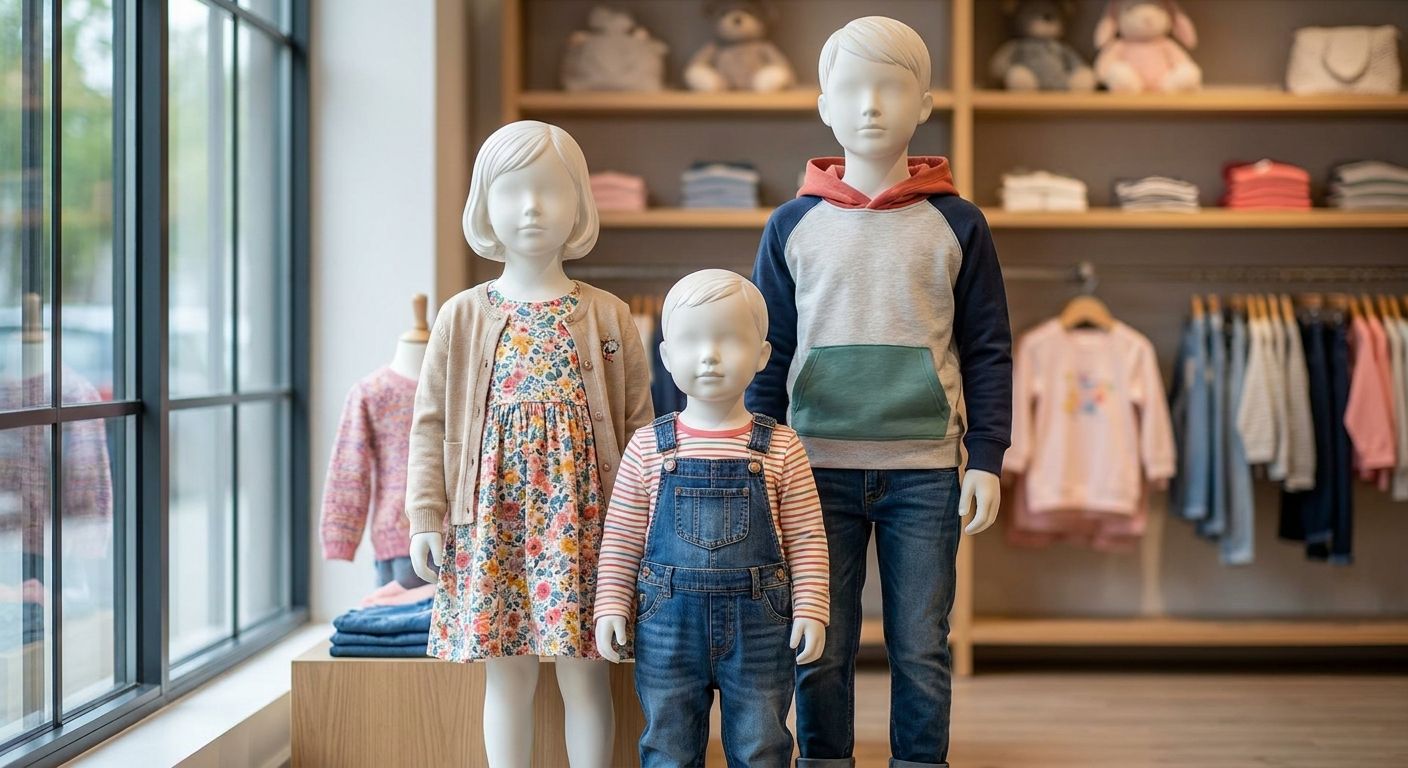
Kids clothing stores lose sales when the mannequin on the floor is really just a scaled-down adult body — shoulders too wide, torso too long, proportions that make a size 4 dress hang wrong. The five picks below cover every part of a children's fashion floor, from newborn racks to pre-teen displays, so you fit the mannequin to the merchandise instead of the other way round.
- Full-Body Standing Child Mannequin ranks best overall among mannequins for kids clothing stores in 2026.
- Headless Child Mannequin wins for stores that restyle racks weekly — no wig or face upkeep to slow you down.
- Toddler and Infant Mannequin fits 0-3 sizing accurately; an adult-scaled body distorts baby clothes badly.
- Whogohb stocks standing, headless and toddler mannequin styles built for Nigerian fashion houses.
- Kids Dress Form is the pick for dressmakers cutting and fitting children's wear, not for shopfront display.
Why this matters
A child's body changes shape faster than an adult's — a 2-year-old's proportions and a 10-year-old's are two different jobs, not one mannequin scaled down. Display a size 6 pinafore on a mannequin built for teen proportions and the fabric pools at the waist; customers notice, and sales drop.
Most Nigerian boutiques and fashion houses stocking children's lines make one of two mistakes in 2026: they buy a single adult-scale mannequin and call it "kids," or they buy the cheapest headless torso without checking if it fits toddler, mid-child or pre-teen sizing. Whogohb carries mannequin styles built around actual child body stages, which is the starting point for getting this right.
What makes the best mannequin for kids clothing stores
- Age-accurate proportions — separate scaling for toddler (ages 0-3), mid-child (4-8) and pre-teen (9-12) bodies
- Stable base and joints — kids' fabrics are lighter, so a mannequin that tips or slouches ruins the display fast
- Easy dressing and undressing — removable limbs or a headless design speed up restocking on high-turnover racks
- Finish that matches your store's look — matte skin-tone, fabric-wrapped or glossy finishes read differently under shop lighting
- Durability for daily handling — staff dress and undress kids' mannequins more often than adult ones because sizes rotate faster
- Fit for the actual merchandise — a dress form for tailoring is not the same purchase as a shopfront display mannequin
At a glance
| Mannequin | Best for | Standout feature | Key limitation |
|---|---|---|---|
| Full-Body Standing Child Mannequin | General kids apparel display | Realistic age-scaled proportions | Takes more floor space per outfit |
| Headless Child Mannequin | High-turnover restyling | Fast dressing, no face/wig upkeep | Less emotional pull for shoppers browsing |
| Toddler and Infant Mannequin | Baby and toddler lines (0-3) | Correct small-body scaling | Not suited to older kids' sizing |
| Poseable/Flexible Child Mannequin | Activewear and movement-led kidswear | Joints hold action poses | Higher handling care than rigid bodies |
| Kids Dress Form | Dressmakers fitting children's wear | Built for pinning and adjusting fabric | Not designed for shopfront display |
1. Full-Body Standing Child Mannequin: best mannequin for general kids apparel display
This is the workhorse of any children's clothing floor — full head-to-toe proportions scaled to a specific age band, standing on a fixed or weighted base. It's the mannequin most Nigerian fashion houses reach for first when setting up a kids' section in 2026, because it shows an outfit the way a parent actually pictures it on their child.
Full-Body Standing Child Mannequin pros:
- Shows complete outfits — top, bottom, shoes — in one display
- Age-scaled proportions read correctly under any store lighting
- Works for window displays and in-store feature racks alike
Full-Body Standing Child Mannequin cons:
- Needs more floor space than a torso-only option
- Dressing takes longer than a headless design when you're rotating stock daily
Best for: stores building a full kids' section rather than a single accent rack. Verdict: Buy.
2. Headless Child Mannequin: best mannequin for high-turnover restyling
A headless mannequin display skips the face and wig entirely, which sounds like a small thing until you're the staff member restocking three times a week. No face means no wig maintenance, no worry about a chipped painted expression, and faster dressing on busy Saturdays.
Headless Child Mannequin pros:
- Dresses and undresses in a fraction of the time
- No wig, makeup or facial finish to maintain
- Keeps shopper attention on the garment, not the face
Headless Child Mannequin cons:
- Less warmth for parents shopping emotionally for a child's outfit
- Still needs correct child-scale proportions below the neckline — a headless adult torso will still fit wrong
Best for: boutiques that swap outfits multiple times a week and need speed over sentiment. Verdict: Buy.
3. Toddler and Infant Mannequin: best mannequin for baby and toddler lines
Toddler and infant sizing (roughly 0-3 years) is its own display problem. Standard "kids" mannequins scaled for a 6-year-old still look wrong on a 12-month romper — the proportions are visibly off to any parent browsing baby clothes.
Toddler and Infant Mannequin pros:
- Matches infant and toddler body proportions instead of a shrunk mid-child scale
- Lightweight, easy to reposition on baby-section shelving
- Reads correctly on rompers, onesies and small dresses
Toddler and Infant Mannequin cons:
- Only useful for the 0-3 size range — doesn't cover the rest of your kids' floor
- Smaller bases can tip more easily if the display shelf isn't stable
Best for: stores or fashion houses running a dedicated baby and toddler section. Verdict: Buy.
4. Poseable/Flexible Child Mannequin: best mannequin for activewear and movement-led kidswear
Jointed, poseable child mannequins hold running, jumping or seated poses, which matters for sportswear, school PE kits and dance-line displays. A rigid standing body can't sell the same story for movement-oriented garments.
Poseable/Flexible Child Mannequin pros:
- Poses match the actual use of the garment — a football jersey looks better mid-action than flat-standing
- Adds visual variety to a floor full of standing mannequins
- Useful for seasonal sportswear or dancewear pushes
Poseable/Flexible Child Mannequin cons:
- Joints need more careful handling than a fixed body
- Overkill for a store that mostly sells everyday dresses and shirts
Best for: stores with a real activewear, sportswear or dance-line assortment. Verdict: Hold — buy only if movement-led kidswear is a real part of your assortment in 2026.
5. Kids Dress Form: best for dressmakers fitting children's wear
A dress form for dressmakers is a tailoring tool, not a shopfront display piece — it's built to hold fabric still for pinning, draping and adjusting during construction, scaled to a child's frame rather than an adult's.
Kids Dress Form pros:
- Pinnable surface built for cutting and fitting, not for retail display
- Correct child-scale measurements save guesswork during construction
- Essential for any fashion house sewing custom children's wear
Kids Dress Form cons:
- Not designed to be seen by shoppers — it's a workroom tool
- A single dress form only covers one size range at a time
Best for: tailors and fashion houses producing custom or made-to-measure children's garments. Verdict: Buy — but only alongside, never instead of, a display mannequin.
How we ranked these
Each pick was judged against the six criteria above: age-accurate proportions, base stability, dressing speed, finish, durability under daily handling, and fit for the actual job — display versus construction. The Full-Body Standing Child Mannequin took the top overall spot because it's the only style that does the complete-outfit job every kids' store needs first; everything else fills a specific gap around it.
“If a mannequin's shoulders sit adult-width, it was never built for children's wear — no amount of styling fixes that.”
Which mannequin should you choose?
Start with a Full-Body Standing Child Mannequin for your main kids' section — it's the safest default for 2026 and covers the widest range of merchandise. Add a Headless Child Mannequin the moment your rack rotation speeds up past twice a week. Bring in a Toddler and Infant Mannequin only once you're carrying a genuine 0-3 assortment, and reserve the Kids Dress Form for the workroom, not the shopfront. Costs vary by height, material and finish — check the current mannequin cost guide for Nigeria before you order in bulk.
Fit out your kids' section
Browse mannequin styles built for Nigerian fashion houses.
FAQ
What's the best mannequin for kids clothing stores in 2026?
The Full-Body Standing Child Mannequin is the best overall choice for a general kids' section because it shows complete outfits with age-accurate proportions. Stores with faster rack rotation should add a Headless Child Mannequin alongside it.
Is a headless mannequin better than a full-body one for kids' clothes?
Neither is universally better — a headless mannequin dresses faster and suits high-turnover racks, while a full-body mannequin sells the complete outfit story better for feature displays. Most kids' stores use both.
Do toddler clothes need a different mannequin than older kids' clothes?
Yes. A mannequin scaled for a 6-year-old distorts a 12-month romper's fit, so 0-3 sizing needs its own toddler and infant mannequin rather than a shrunk mid-child body.
How much do kids mannequins cost in Nigeria in 2026?
Cost depends on the mannequin's height, material and finish, and pricing varies by supplier and order size. Check a current mannequin cost breakdown before ordering in bulk rather than relying on last year's figures.
Can I use an adult mannequin for children's clothing?
No — an adult-scaled body has wider shoulders and a longer torso than any child age band, so kids' garments hang wrong and misrepresent the fit. Age-scaled mannequins are built specifically to avoid this.
What's the difference between a kids dress form and a display mannequin?
A dress form is a tailoring tool built for pinning and draping fabric during construction, while a display mannequin is built to be seen by shoppers on the floor. Fashion houses making custom children's wear typically need both.
Are poseable mannequins worth it for a kids clothing store?
Only if your assortment includes real activewear, sportswear or dance-line pieces where a movement pose sells the garment better than a static stance. Everyday dress and shirt assortments don't need the extra cost.
One last thing
The single most common mistake on Nigerian kids' clothing floors isn't the mannequin choice at all — it's mixing age scales on one rack. A toddler mannequin next to a pre-teen mannequin on the same shelf confuses the eye about sizing before a customer even reads the tag; group by age scale first, mannequin style second.